Why integrating practical skills, professional experience and entrepreneurial learning into education could help more people build careers or start businesses.
The purpose of education extends beyond achieving qualifications. It should equip individuals with the knowledge, capabilities and confidence to participate in society and economic life. Across the United Kingdom, schools, further education colleges, universities and training providers support personal and professional development. Yet an important question remains: how effectively can learners translate what they know into what they can do?
For many people, completing a qualification is a major achievement. The next transition may still require communication, commercial awareness, problem-solving, digital literacy and opportunities to demonstrate capability. Rather than treating employability and enterprise as activities that begin only after education, we should consider how these can be integrated into learning itself.
The UK education system: strong foundations in a changing labour market
The UK provides academic qualifications, technical and vocational education, apprenticeships, professional certifications and other routes into learning. These pathways serve different purposes. Their value should not be reduced to employment outcomes alone: education also supports critical thinking, citizenship and intellectual curiosity. Nevertheless, the relationship between education and work deserves continued scrutiny.
According to the Higher Education Statistics Agency (HESA, 2026), 87% of responding graduates from the 2023/24 cohort were in work or further study around 15 months after leaving higher education. The same statistics reported 57% in full-time employment and 7% unemployed. These are survey activity categories, not an unemployment rate comparable with the Labour Force Survey. They show broadly positive transitions alongside real variation in graduate circumstances.
Employer evidence illustrates another dimension. Skills England (2026) reports that skill-shortage vacancies represented 27% of vacancies in the 2024 Employer Skills Survey, compared with 36% in 2022. Recruitment difficulties can persist even when people are seeking work. The challenge is therefore not merely how many people hold qualifications, but also how effectively learning connects to professional capability, opportunity and local labour-market needs.
From subject knowledge to practical capability
Theoretical understanding is essential. Technical expertise without adequate knowledge can be ineffective or unsafe. However, knowledge becomes more useful when learners can apply concepts to unfamiliar tasks, compare evidence and make reasoned judgements.
Skills England (2026) highlights transferable capabilities such as communication, financial literacy, teamwork and interview preparation, together with the challenge young people face when translating informal experience into language recognised by employers. A business student may know marketing theory yet have limited experience of real customer research or budgeting. A computing student may understand programming while needing practice with client requirements, teamwork and technical communication.
The response should not be to weaken academic content. It should be to make opportunities for application, reflection and demonstration integral to the curriculum.
Embedding employability through authentic learning
One approach is to connect classroom knowledge to realistic challenges. Mathematics can incorporate budgeting and pricing; science projects can address local environmental issues; media students can design an evidence-based communication campaign. The academic concept remains central, while the context illustrates why it matters.
Employability also needs visible outcomes. Learners can practise team responsibilities, present recommendations, analyse workplace scenarios and explain how feedback changed their work. The Gatsby Benchmarks (Gatsby Education, 2024) support meaningful links between curriculum learning, careers guidance, encounters with employers and experiences of workplaces in England. Access to those experiences should not depend solely on family or professional networks.
Employer participation can extend beyond occasional guest talks. Structured project briefs, mentoring, work experience and formative feedback can connect education with actual professional expectations while preserving educational independence.
Entrepreneurship education: preparing people to create opportunities
Employment is not the only possible direction. Some learners may explore self-employment, freelancing, social enterprise or business creation. That path requires more than an attractive idea: it demands market understanding, customer insight, financial planning, commercial communication, operational judgement and awareness of relevant legal obligations.
The Quality Assurance Agency for Higher Education (2024) recognises enterprise and entrepreneurship education as an area for systematic development. In practical terms, learners can identify a problem, interview prospective customers, test a small proposition, estimate costs, analyse risks and revise their plans using evidence. The objective is not to require every learner to register a company. It is to cultivate initiative, informed opportunity recognition and the ability to create value responsibly.
These capabilities also matter inside established organisations. An employee improving a service and a founder creating a new offering may rely on overlapping habits of inquiry, collaboration, financial awareness and adaptation.
Introducing the proposed Mentorentia Dual-Destination Capability Bridge
To connect these ideas, we propose the Mentorentia Dual-Destination Capability Bridge, an original synthesis developed for this article. It is a conceptual, evidence-informed proposal rather than a tested educational theory. Its particular arrangement, terminology and visual presentation are presented as Mentorentia’s proposed approach; its elements build on established ideas in experiential learning, careers education and competency development.
The bridge is designed to carry learners from knowledge towards two possible, interconnected destinations: professional employment and entrepreneurship or self-employment. It consists of five linked stages, three cross-cutting supports and an ongoing feedback loop.
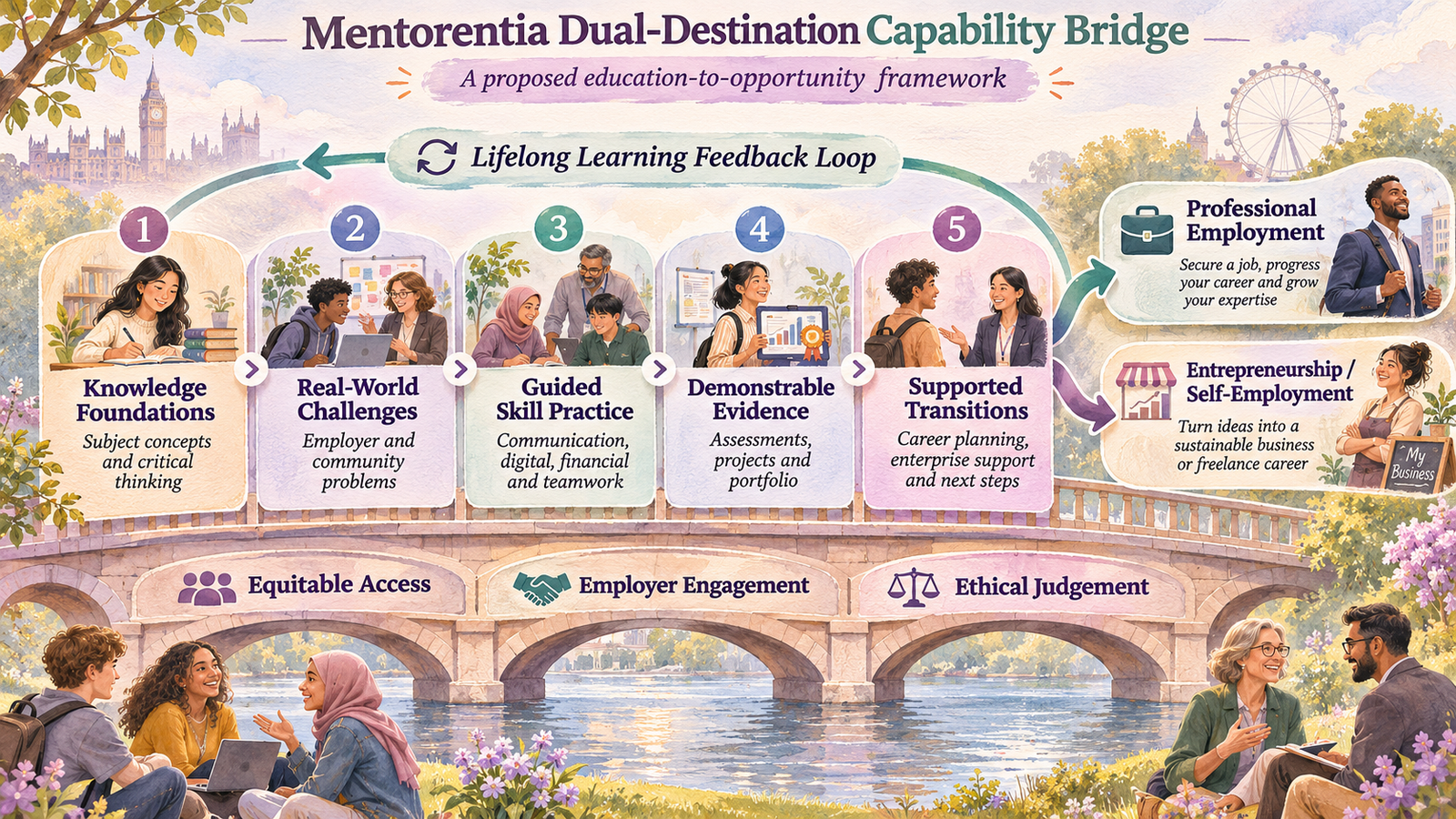
Stage 1 — Knowledge foundations
Learners develop subject understanding, critical thinking and the professional principles needed to interpret information. Quality checks should test explanation and reasoning, not only recall. Foundational knowledge remains valuable whether the learner ultimately pursues a regulated profession, an employed role or a business opportunity.
Stage 2 — Real-world challenges
Knowledge is connected with authentic problems identified through employers, communities, public services or local enterprises. A learner might investigate why customers abandon an online purchase, why a community organisation struggles to reach users or why a service process creates delays. The challenge should be proportionate, ethical and feasible within the learning context.
Stage 3 — Guided skill practice
Learners apply communication, teamwork, digital skills, financial literacy, problem-solving and professional judgement with appropriate support. Educators model reasoning, facilitate practice and gradually reduce guidance as capability strengthens. Practical tasks should be inclusive, accessible and suited to the level of the qualification or course.
Stage 4 — Demonstrable evidence
Learners produce something others can evaluate: an assessment, case analysis, portfolio, prototype, presentation, business proposition or supervised work output. The evidence should make the learning outcome observable. Certificates can recognise assessed learning, but should not be presented as proof of unrelated workplace competence or a promise of employment.
Stage 5 — Supported transitions
The learner receives structured help in translating evidence into a next step. For employment, this may involve role research, professional portfolios, applications, interviews and employer feedback. For entrepreneurship, it may involve market validation, lawful business setup, pricing, mentoring and access to further specialist support. Learners should be free to switch between the two directions throughout their careers.
Three supports beneath the bridge
Equitable access: learning opportunities should recognise differences in finances, disability, caring commitments, technology access and social networks. Employer engagement: real-world input helps keep practical tasks meaningful without allowing short-term employer demands to displace broader education. Ethical judgement: privacy, fairness, sustainability, safety and responsibility should inform decisions across all stages.
The feedback and lifelong-learning loop
The framework is not a one-way conveyor belt. Learners, employers and educators use feedback from practical performance, job transitions and business experimentation to improve subsequent learning choices. A graduate who enters employment may later start a business; an entrepreneur may return to formal training or paid employment. Progress is iterative, not a single destination.
How the bridge could work in practice
Consider a learner completing a short digital-marketing programme. They first understand audience research and campaign planning. Next, they examine a realistic challenge from a small organisation. With guidance, they create and test sample content, interpret basic performance indicators and document a portfolio. The same evidence can help explain their abilities to an employer or support cautious exploration of freelance services. Neither route is guaranteed; both become more tangible because the learner can demonstrate what they have practised.
A similar process could be adapted for project management, horticulture, coding, health-related non-clinical training or customer service, provided the tasks and claims remain appropriate to each profession and its regulatory requirements.
The role of short courses and lifelong learning
Formal qualifications provide important foundations, but skill requirements evolve after graduation. Skills England (2026) discusses the need for flexible, shorter pathways to support upskilling and reskilling alongside colleges, universities and apprenticeships. Well-designed short courses can complement rather than replace established qualifications.
A graduate may strengthen data analysis; an experienced employee may develop supervisory capability; an aspiring business owner may study customer discovery or bookkeeping. To be credible, courses need transparent outcomes, suitable assessments, reliable sources and honest descriptions of what completion enables.
What education providers and policymakers could do
Schools could incorporate applied career examples into existing subjects. Further education providers could use industry-informed practical assessments. Universities could encourage interdisciplinary projects and enterprise experience alongside academic study. Employers could provide meaningful challenges and feedback. Learning platforms could make focused skills development more accessible across career stages.
Evaluation should go beyond enrolment and completion. Useful measures may include portfolios, demonstrated skill gains, access to work experience, learner confidence, subsequent progression and the support needed for those not progressing as expected. Any attribution of employment or business outcomes to a single intervention should be cautious: economic conditions, discrimination, local opportunities and individual circumstances also matter.
Towards knowledge, purpose and progress
The future of UK education should not be framed as a choice between academic knowledge and practical skills. Both are necessary. Strong foundations support understanding; application supports capability; feedback supports sound judgement.
At Mentorentia, we see an opportunity for education to help people develop knowledge with purpose and make meaningful progress towards professional ambitions. The proposed Dual-Destination Capability Bridge offers one way to organise that ambition for discussion, adaptation and future evaluation. Its value will ultimately depend on whether educators and learners can test it, refine it and demonstrate meaningful results.
References
- Higher Education Statistics Agency. (2026, June 4). 87% of 2023/24 graduates in work or further study according to new official statistics. https://www.hesa.ac.uk/news/04-06-2026/87pc-202324-graduates-in-work-study.
- Skills England. (2026). Skills England annual skills report 2026. https://www.gov.uk/government/publications/skills-england-annual-skills-report-and-sectoral-skills-needs-assessments-2026/skills-england-annual-skills-report-2026.
- Gatsby Education. (2024). Good career guidance: The Gatsby Benchmarks. https://www.gatsbybenchmarks.org.uk/.
- Quality Assurance Agency for Higher Education. (2024). Enterprise and entrepreneurship education: Guidance for UK higher education providers. https://www.qaa.ac.uk/the-quality-code/enterprise-and-entrepreneurship-education.
Further reading
- Employer skills survey 2024: UK findings. https://www.gov.uk/government/publications/employer-skills-survey-2024-uk-findings.
- Careers guidance and access for education and training providers. https://www.gov.uk/government/publications/careers-guidance-provision-for-young-people-in-schools/careers-guidance-and-access-for-education-and-training-providers.
- Graduate Outcomes 2023/24 data release (Jisc). https://www.jisc.ac.uk/article/graduate-outcomes-2023-24-data-release.